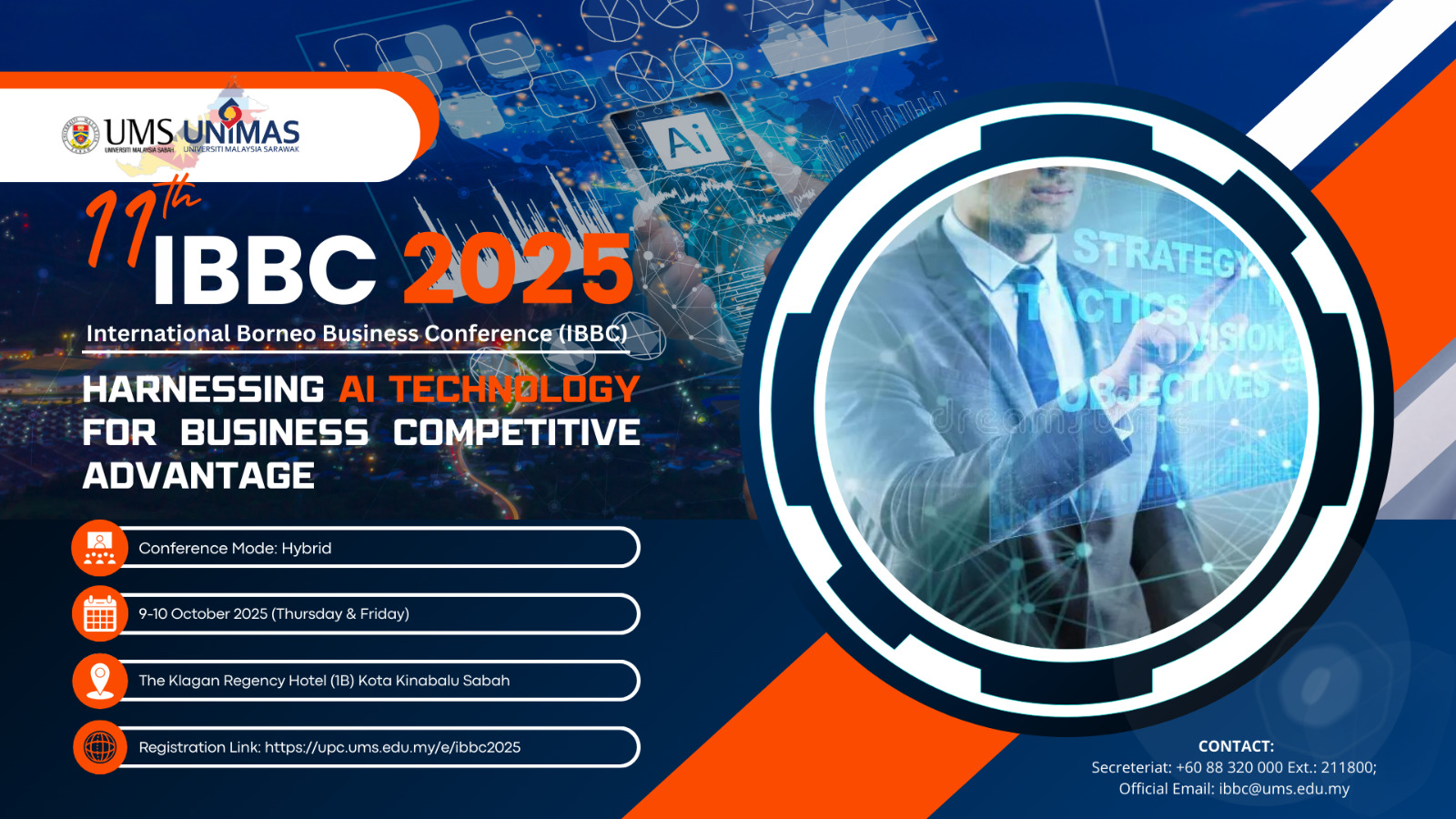
Description
Breakout Rooms (Session 1):
• Track 1: AI in Business & Innovation
• Track 2: AI and Economic Growth
• Track 3: AI in Accounting & Finance
• Track 4: Emerging AI Applications
This review synthesizes research on "transparency in AI marketing, consumer trust, brand reputation" to address the fragmented understanding of how transparency initiatives influence consumer perceptions and brand outcomes amid ethical and practical challenges. The review aimed to evaluate transparency’s role in fostering trust and brand reputation, benchmark ethical frameworks, identify...
In Thailand’s rapidly evolving business landscape, artificial intelligence (AI) is significantly altering work dynamics, influencing employees' well-being and productivity. This study investigates the impact of AI trust on employee well-being (life satisfaction, career satisfaction) and productivity (task performance, creative performance), emphasizing the crucial mediating role of employee-AI...
The motivation of this study is to examine the short run and long run relationships between different proxies for non-life insurance and selected macroeconomics variables in Malaysia. Non-life insurance is represented by penetration rate (NLIPR), density (NLID), net written premium (NLINWP), adjusted premium for population and GDP (NLIAP) and claim ratio (NLICR), while the selected...
The purpose of the study is to examine the relationship between Competitive Pressure (CP), Top Management Commitment (TMC), Employee Adaptability (EA), External Support (ES), Organization Readiness (OR) and Artificial Intelligence Adoption (AIA) among SMES operating in Sabah, Malaysia. By employing judgemental sampling a total of 196 respondents were involved (i.e., owners or managers) in...
ABSTRACT
The purpose of the study is to examine the relationship between Competitive Pressure (CP), Top Management Commitment (TMC),
Employee Adaptability (EA), External Support (ES), Organization Readiness (OR) and Artificial Intelligence Adoption (AIA) among SMES operating in Sabah, Malaysia. By employing judgemental sampling a total of 196 respondents were involved (i.e., owners or...
By leveraging AI technologies across agriculture, logistics, and resource management, countries can address key dimensions of food security availability, access, utilization, and stability. Using a balanced panel dataset comprising 71 countries over the period 2019 to 2024, this study empirically assesses the impact of AI adoption on national food security outcomes. Employing generalized...
Poster as per attached.
This study examines the impact of Information and Communication Technology (ICT) on agricultural productivity in Malaysia using the Autoregressive Distributed Lag (ARDL) model, exploring both short-run and long-run relationships while identifying key determinants of agricultural efficiency and barriers to ICT adoption. Utilizing secondary data from 1991 to 2023 sourced from the World Bank, the...
This study examines the influence of menu diversity, price perception, and social media on repurchase interest, mediated by customer satisfaction, among traditional food MSMEs specializing in Gado-Gado, Ketoprak, and Karedok in South Tangerang. Primary data were collected through questionnaires distributed to 85 respondents, selected using purposive sampling based on their frequency of...
The rapid rise of online marketplaces in Indonesia has prompted businesses to adopt artificial intelligence (AI)-powered personalization tools to enhance user experience and foster loyalty. This research aims to analyze the effectiveness of AI personalization features—specifically chatbots and recommendation engines—in increasing customer satisfaction and loyalty. By examining how these tools...