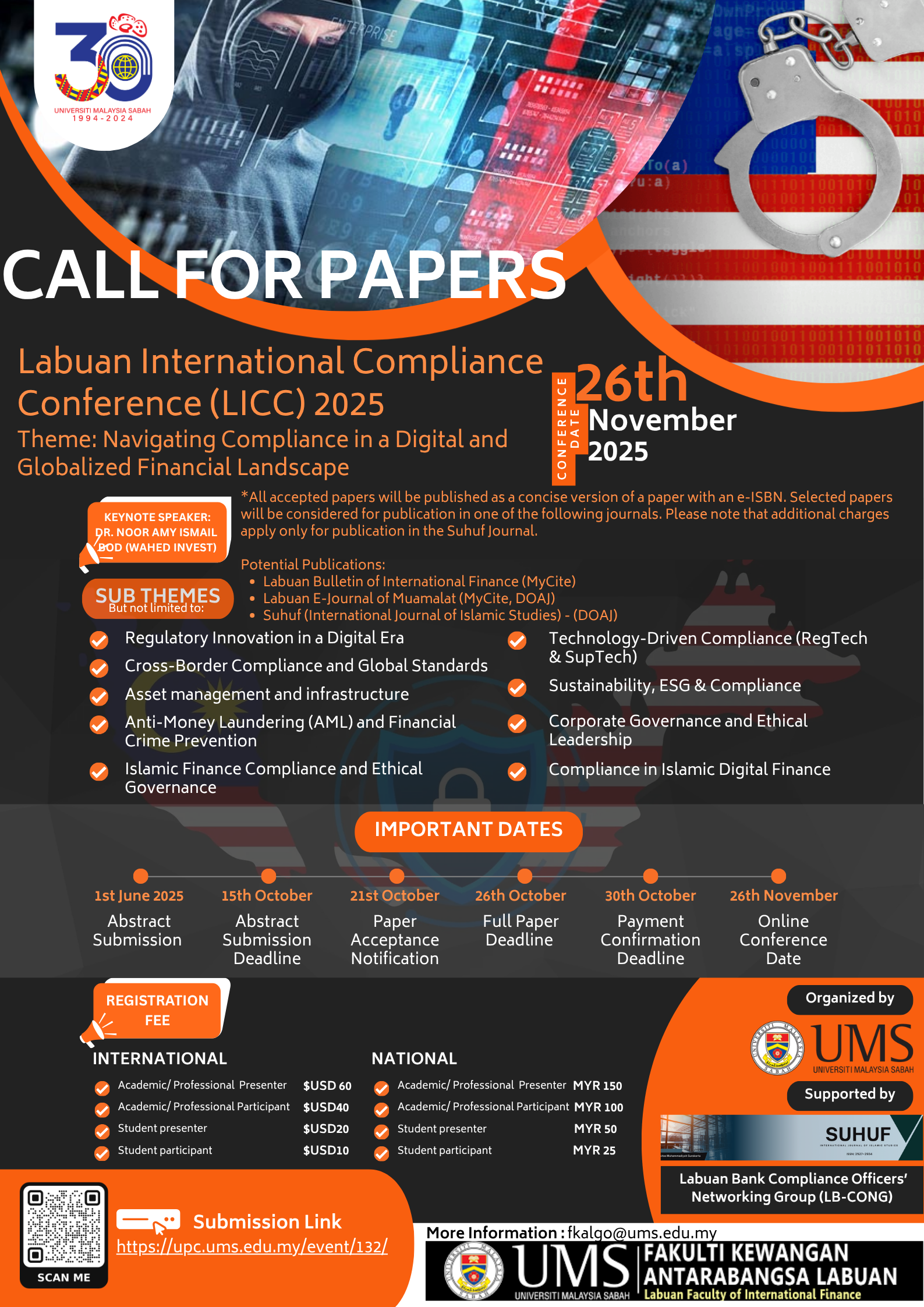
Speaker
Description
Enhancing Participation and Sustainability of Malaysia’s Private Retirement Scheme (PRS): Key Barriers
Abstract
The purpose of this study is to investigate the main obstacles influencing the Private Retirement Scheme's (PRS) long-term viability and participation in Malaysia. Notwithstanding government incentives and industry-led awareness campaigns, PRS, a voluntary long-term savings plan that was introduced in 2012 to supplement the Employees Provident Fund (EPF) in addressing retirement income adequacy, has remained underutilized. The uptake is significantly skewed towards urban, higher-income earners, and participation rates are still low as of 2024 (Private Pension Administrator Malaysia, 2024). The lack of integration of Environmental, Social, and Governance (ESG) investment principles, competing short-term priorities, low financial literacy, and low trust in investment products are some of the obstacles that continue to prevent wider adoption. In order to demonstrate how ESG-aligned strategies can improve uptake and sustainability, this study looks at structural, behavioral, and policy-related barriers to PRS participation. The results are intended to help regulators, policymakers, and PRS providers implement specific reforms that enhance inclusivity, incorporate ESG factors, and fortify Malaysia's retirement security framework.
Keywords: Private Retirement Scheme, ESG, Retirement Planning, Financial Literacy, Policy Recommendations
1.0 Introduction
The mandatory Employees Provident Fund (EPF), which has over 15 million members, dominates Malaysia's retirement scene, although questions about retirement adequacy still exist. More than half of EPF members over 55 have savings of less than RM50,000, which is significantly less than the suggested minimum amount (EPF, 2024). To supplement EPF savings, the Securities Commission Malaysia (SC, 2024) regulated the PRS, a voluntary long-term savings and investment plan that was first offered in 2012.
Less than 10% of Malaysia's working-age population, or 580,000 members, had PRS assets under management (AUM) of RM6.4 billion as of 2024 (PPA, 2024). There is little uptake in the rural and informal sectors, and participation is concentrated among higher-income, urban individuals.
Important obstacles still exist even with tax incentives of up to RM3,000 per year (MOF, 2024):
• Insufficient financial knowledge when it comes to retirement planning.
• Middle- and lower-income earners' competing financial priorities
• Perceived investment risks and a lack of confidence in intermediaries
• Lack of ESG-aligned investment options that limit their appeal to investors who care about sustainability.
To ensure resilience and a sustainable economic contribution, pension funds around the world are aligning with ESG frameworks (OECD, 2023). Incorporating ESG into PRS can encourage involvement and support the sustainability, inclusivity, and prosperity pillars of the Malaysian government's Madani Economic Framework.
3.0 Data and Methodology
3.1 Data Sources
No. Source Data Provided
1 Private Pension Administrator (PPA) Malaysia (2024) Annual PRS Statistics: membership, assets under management (AUM), fund performance
2 Employees Provident Fund (EPF) (2024) Retirement adequacy data, member savings distribution
3 Securities Commission Malaysia (SC) (2024) PRS Guidelines, Annual Reports, ESG disclosure frameworks
4 Ministry of Finance (MOF) (2024) Tax incentive structures, Budget allocations
5 OECD (2023) Comparative voluntary pension benchmarks
6 UN Principles for Responsible Investment (UN PRI) (2024) ESG investment integration principles
7 World Bank & ILO (2023) Pension system inclusion and sustainability reports
3.2 Methodology
Approach Specific Method Description
Quantitative Analysis Time-series analysis Analyse PRS membership and AUM growth (2014–2024)
Cross-sectional analysis Compare participation by income, age, geography
ESG portfolio comparison Compare ESG allocation in PRS vs regional pension schemes
Qualitative Analysis Policy review Analyse SC PRS Guidelines and MOF tax incentives
Thematic coding Extract recurring participation barriers from literature
ESG gap assessment Benchmark PRS disclosures against SC SRI Guidelines & UN PRI principles
Policy Linkage Assessment Framework mapping Align findings with Madani Economic Framework pillars
Table 1: Licensed PRS Providers and ESG Disclosure Indicators
PRS Provider ESG Disclosure in Annual Reports
Affin Hwang Asset Management Partial
AmInvest Asset Management Yes
CIMB-Principal Asset Management Yes
Kenanga Investors Berhad Partial
Manulife Investment Management Yes
Public Mutual Berhad No
RHB Asset Management Yes
AHAM Asset Management (formerly Atlas One) Partial
Principal Asset Management Yes
AIA Pension and Asset Management Partial
Source: Compiled by authors from PRS Provider annual reports.
References
Private Pension Administrator Malaysia (PPA). (2024). Annual Report 2024.
https://www.ppa.my
Employees Provident Fund (EPF). (2024). Annual Report 2023.
https://www.kwsp.gov.my/en/corporate/news-highlights/publications
Securities Commission Malaysia (SC). (2024). Annual Report 2024.
https://www.sc.com.my/resources/annual-report
Securities Commission Malaysia (SC). (2024). Guidelines on Private Retirement Schemes.
https://www.sc.com.my/regulation/guidelines/private-retirement-scheme
Ministry of Finance Malaysia (MOF). (2024). Budget 2024 Speech & Economic Outlook.
https://www.mof.gov.my/portal/en/budget-2024
Organisation for Economic Co-operation and Development (OECD). (2023). Pensions at a Glance 2023: OECD and G20 Indicators.
https://www.oecd.org/pensions/pensions-at-a-glance-19991363.htm
World Bank. (2023). Malaysia Economic Monitor: Securing the Future – Pension Systems and Retirement Readiness.
https://documents.worldbank.org/en/publication/documents-reports/documentdetail/099046503012328460/p174916078122609a0b9a1035b869d1a8df
International Labour Organization (ILO). (2023). World Social Protection Report 2023–25.
https://www.ilo.org/global/research/global-reports/world-social-protection-report
Affin Hwang Asset Management
https://affinhwangam.com
Manulife Investment Management
https://www.manulifeim.com.my